The companies that keep the lights on
Now we know the stack — ten levels from customer revenue down to mining. But which specific companies sit at each level, where are they located, and where does the money actually concentrate? Let's put names on it.
Because the real story of the AI economy is about specific companies in specific countries controlling specific capabilities, and the profit they capture as a result. When you name them, the picture gets a lot more interesting — and a lot more fragile.
The map #
Here is every major layer of the AI supply chain with the companies that matter most in each one.
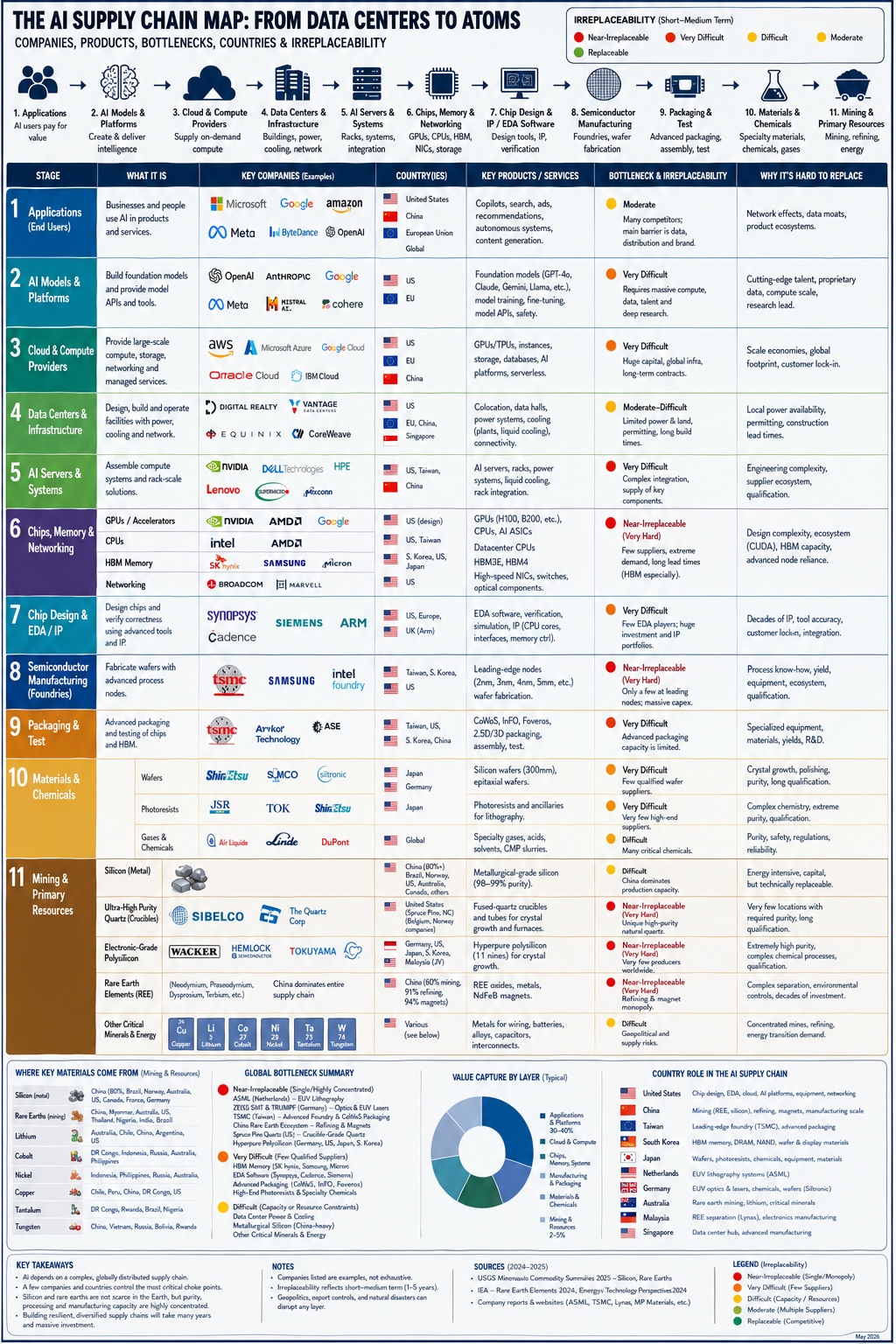
AI applications and model providers #
OpenAI, Anthropic, Google DeepMind, Meta AI, xAI — mainly United States.
These are the companies most people think of when they say "AI." They build and operate the foundation models, the consumer products, the APIs developers plug into. They own the customer relationship. In theory, that is the most valuable position in the stack.
In practice, they are also the companies paying the highest bills. Every model they train and every inference they serve consumes compute that has to be bought from someone further down. The fundamental economic question here — whether AI revenue actually covers AI costs — is still not fully answered.
Cloud and hyperscale infrastructure #
Amazon AWS, Microsoft Azure, Google Cloud, Oracle — United States. Specialist GPU clouds globally.
Cloud companies sit between the model builders and the physical machines. They finance enormous data centres, fill them with the most expensive hardware on the planet, and sell the result by the hour.
Besides that, they are also designing their own chips:
- AWS builds Trainium for training and Inferentia for inference
- Google has its own TPU family
- Microsoft developed Maia
- Meta designs MTIA accelerators
Each of these reduces their dependence on NVIDIA at the margin. None of them replaces NVIDIA. At least not yet.
GPU and accelerator platforms #
NVIDIA — United States. AMD — United States.
NVIDIA is the dominant force in AI compute. Its H-series and B-series GPUs run most of the world's AI workloads. But calling NVIDIA a chip company undersells it. What NVIDIA actually sells is a platform: GPU hardware, the CUDA programming environment, AI libraries, compilers, InfiniBand networking, and increasingly, complete rack-scale systems pre-engineered for AI workloads.
That platform is the moat. A company can technically replace NVIDIA GPUs with AMD Instinct accelerators. What it cannot easily replace is the years of software written for CUDA, the trained engineers, the existing toolchains, and the infrastructure integration. Migration is possible but expensive and slow.
AMD is a genuine alternative at the hardware level. Its Instinct MI300-series GPUs are competitive on specifications. It is working to close the software gap. For now it remains the credible challenger rather than the co-equal.
Custom AI chips and connectivity silicon #
Broadcom, Marvell, Arm — United States and United Kingdom.
Large hyperscalers increasingly design their own AI accelerators, but they rarely do it entirely alone. Broadcom and Marvell provide custom silicon — specialised networking chips, optical DSPs, Ethernet switches and custom ASIC design services. Arm provides the processor IP that appears inside custom chips across dozens of companies.
This layer is what lets Google, Amazon and Meta build alternatives to general-purpose GPUs. They are reducing their dependency on a single supplier for specific, well-defined workloads.
Server assembly #
Foxconn/Hon Hai, Quanta/QCT, Wistron, Wiwynn, Supermicro — Taiwan and United States. Dell, HPE — United States.
Chips do not deploy themselves. Taiwanese original design manufacturers (ODMs) and original equipment manufacturers (OEMs) take the chips, memory, networking, power systems and cooling hardware and assemble them into deployable servers and racks.
Taiwan is disproportionately important at this layer. Companies like Quanta and Foxconn build enormous quantities of AI servers for the hyperscalers. When people worry about Taiwan's geopolitical position, they are partly worried about this: the assembly capacity for the world's AI hardware is concentrated on a single island.
AI networking #
NVIDIA, Broadcom, Arista, Marvell — United States.
A single GPU is not useful for large AI workloads. You need thousands of them talking to each other at enormous speed.
NVIDIA's InfiniBand interconnects are the dominant technology for tightly coupled AI training clusters. Broadcom and Arista supply high-speed Ethernet alternatives. Marvell provides optical DSPs that convert electrical signals to light for long-distance interconnects.
As AI cluster sizes grow, the economics of networking become more important, not less. The value of an expensive GPU depends heavily on whether the network can keep it continuously supplied with data.
High-bandwidth memory and storage #
SK hynix, Samsung — South Korea. Micron — United States.
High-bandwidth memory (HBM) is the technology that sits right next to the processor and feeds it data fast enough to keep it busy. Without enough HBM, even the most powerful GPU is starved.
SK hynix was the first to scale HBM into high-volume production and supplies a large share of the HBM inside NVIDIA's leading chips. Samsung and Micron are significant producers. All three are manufacturing at capacity and expanding.
The HBM market transformed memory from a commodity into a profit pool. SK hynix reported a 49% operating margin in 2025 — a number that was essentially unimaginable in the memory industry a decade ago. That tells you everything about what happens to economics when a technically difficult component becomes the system bottleneck.
Leading-edge foundry and advanced packaging #
TSMC — Taiwan. Samsung Foundry — South Korea. Intel Foundry — United States.
This is the single most critical layer in the entire stack.
TSMC fabricates the leading-edge logic dies inside most of the world's AI chips — NVIDIA GPUs, AMD accelerators, Google TPUs, Apple processors, Broadcom networking chips, AWS Trainium. It also performs advanced packaging, combining processor dies with HBM stacks into the final package using its CoWoS technology.
TSMC reported a 59.9% gross margin for full-year 2025.[1] For a contract manufacturer, that is an extraordinary figure. It reflects what happens when you combine technical leadership, enormous scale, deep customer integration and a capability that almost nobody else can reproduce.
Samsung Foundry is the main alternative. It can fabricate leading-edge chips and has its own advanced packaging. Intel Foundry is rebuilding its manufacturing capabilities and has received substantial US government support. Neither is currently a complete substitute for TSMC at AI scales.
Chip-design software #
Synopsys, Cadence — United States. Siemens EDA — Germany. Arm — United Kingdom.
You cannot design a modern AI chip without EDA software. The logic is that simple. A chip with billions of transistors cannot be placed and routed manually — you need software to do circuit design, physical layout, timing analysis, power analysis, simulation, verification, manufacturing preparation and thermal modelling.
Synopsys and Cadence dominate this market. Siemens EDA (formerly Mentor Graphics) is the third significant player. Together, the US-dominated EDA ecosystem is effectively indispensable. Cadence reported a 44.6% non-GAAP operating margin in 2025 — high-margin software capturing enormous value while consuming essentially no physical material.
Arm provides the processor IP that underlies chips from Apple, Qualcomm, Amazon's Graviton, and dozens of others. Its architecture appears inside the host CPUs on AI servers even when the accelerators come from elsewhere.
Semiconductor manufacturing equipment #
ASML — Netherlands. Applied Materials, Lam Research, KLA — United States. Tokyo Electron, Advantest — Japan.
Foundries need machines to make chips. That equipment is its own complete industry.
ASML reported €32.7 billion in revenue in 2025 at a 52.8% gross margin.[2] It is the sole manufacturer of the EUV lithography machines required for the most advanced semiconductor nodes. Without EUV lithography, the leading-edge chips that power AI cannot be made. There is no current alternative supplier.
Applied Materials, Lam Research and Tokyo Electron supply the other process equipment: deposition, etching, cleaning and ion implantation tools that process wafers through hundreds of steps. KLA provides inspection and metrology systems that tell the fab whether the process is working correctly. Advantest and Applied Materials test the finished chips.
The suppliers behind the equipment #
ZEISS SMT, TRUMPF — Germany. VAT Group — Switzerland. Specialty suppliers across US, Europe and Japan.
ASML's EUV machine depends on components made by other companies:
- ZEISS Semiconductor Manufacturing Technology makes the ultra-precision mirrors that shape EUV light inside the machine. No other company currently produces these at the required specification.
- TRUMPF makes the high-power laser system that generates EUV light by firing pulses at molten tin droplets. No other company currently provides this at commercial scale.
- VAT Group in Switzerland makes specialised vacuum valves used throughout semiconductor deposition and etching equipment.
These companies are the hidden pins on which the entire advanced-AI production system rests.
Semiconductor materials #
Shin-Etsu, SUMCO — Japan. Wacker Chemie, Siltronic — Germany. JSR, TOK — Japan. GlobalWafers — Taiwan. SK Siltron — South Korea. Entegris — United States.
Chip fabrication requires extraordinary materials: semiconductor wafers at atomic flatness tolerances, photoresists that define circuit patterns, ultra-pure process gases, deposition precursors, cleaning chemicals and packaging materials.
Japan dominates many of these categories. Shin-Etsu and SUMCO are the world's leading wafer producers. JSR and Tokyo Ohka Kogyo produce critical photoresists. Japanese chemical companies supply many of the specialty materials that foundries depend on.
The key word here is qualification. A semiconductor fab cannot swap a chemical supplier the way you switch coffee brands. Even a nominally identical material may behave differently at atomic scales, affecting yields and requiring months or years of qualification. That is what makes materials companies stickier than their commodity pricing suggests.
Data-centre infrastructure #
Schneider Electric — France. Vertiv — United States. Eaton, Emerson — United States. ABB, Siemens — Europe.
Every data centre needs power management, cooling, uninterruptible power supplies, switchgear and control systems. As AI racks get denser and liquid cooling becomes standard, this layer has moved from commodity to specialised engineering.
Vertiv reported a 23.2% adjusted operating margin in Q4 2025. Schneider Electric reported 18.7% adjusted EBITA for 2025. These are substantially lower than NVIDIA or TSMC, but meaningfully higher than commodity manufacturing — and trending upward as liquid cooling complexity increases.
Power grid #
Regional utilities, grid operators, engineering contractors, transformer manufacturers.
The most fundamental constraint in AI infrastructure right now is electricity.
A data centre can be designed in months. Building it takes a year or two. Getting the power connected can take three to five years in some regions. Transmission permits, substation construction, transformer lead times, grid connection queues — these are the blockers that are delaying billions of dollars of announced AI investment.
This layer has no dominant global company. It is a collection of regional utilities, local engineering contractors, and equipment manufacturers. The economic power is low and distributed. The strategic importance is absolute.
Nuclear power supplies about 20% of US electricity[3] — and US nuclear plants have historically sourced a significant share of their enriched uranium from Russia, through Rosatom's export subsidiary TENEX. Enrichment is the step that actually makes uranium usable as reactor fuel, and the US largely dismantled its own enrichment capacity after the Cold War. That left American nuclear operators dependent on a country that is, simultaneously, a geopolitical adversary. According to the EIA's 2024 Uranium Marketing Annual Report, Russia still accounted for 20% of enrichment services delivered to US reactors in 2024 — even after the ban.[4]
The US passed the Prohibiting Russian Uranium Imports Act in May 2024, banning Russian enriched uranium — but with waivers available through 2027 to prevent immediate plant shutdowns.[5] The fact that waivers were necessary tells you the dependency was real. One fifth of the US grid, which powers the data centres running the AI applications at the top of this stack, was partly fuelled by a country that most AI companies would not list anywhere in their risk disclosures.
The real cost of one AI server #
Here is the full economic ancestry of a single rack of AI hardware arriving at a data centre:
Cloud operator
    buys rack from
Server ODM (Quanta, Foxconn, Supermicro)
    which buys the accelerator platform from
NVIDIA / AMD / custom chip designer
    which depends on
TSMC fabrication (leading-edge logic)
    plus
SK hynix / Samsung / Micron (HBM)
    combined through
TSMC CoWoS advanced packaging
    manufactured using
ASML EUV + Applied Materials + Lam + KLA tools
    which contain
ZEISS optics + TRUMPF lasers + VAT vacuum valves
    operated with
Shin-Etsu wafers + JSR photoresists + specialty gases + chemicals
    ultimately derived from
mining + refining + electricity + precision machinery
The cloud company receives one rack. Economically, it has purchased the collective output of hundreds of companies across dozens of countries.
Money accumulation #
The profit figures tell the story more clearly than any description.
| Company / layer | Reported margin | What it reflects |
|---|---|---|
| NVIDIA FY2026[6] | 71.1% gross margin | Accelerator architecture, CUDA platform, networking, rack integration |
| TSMC 2025[1] | 59.9% gross margin | Leading-edge process knowledge, yield, scale, packaging |
| ASML 2025[2] | 52.8% gross margin | The only EUV machine on the planet |
| SK hynix 2025 | 49% operating margin | HBM scarcity turned memory into a bottleneck |
| Cadence 2025 | 44.6% non-GAAP operating margin | Software that every chip designer needs |
| Vertiv Q4 2025 | 23.2% adjusted operating margin | Specialised power and cooling for dense AI racks |
| Schneider Electric 2025 | 18.7% adjusted EBITA | Industrial-scale infrastructure margin |
The pattern is consistent: the higher a company sits in intellectual property and scarcity, the more it captures per dollar of product. NVIDIA captures more per chip than the server assembler captures per rack. ASML captures more per machine than the construction firm that builds the fab.
This does not mean the lower layers are unimportant. A transformer shortage can stop a data centre just as effectively as a GPU shortage. The economic power is concentrated near the top; the physical dependency runs through every layer.
The concentration country by country #
| Tier | Country | What it controls |
|---|---|---|
| 1 — Nearly unique | Netherlands | EUV lithography |
| 1 — Nearly unique | Germany | EUV optics and lasers (ZEISS, TRUMPF) |
| 1 — Nearly unique | Taiwan | Leading-edge fabrication and advanced packaging |
| 2 — Essential clusters | United States | AI chip design, EDA, cloud platforms, semiconductor equipment |
| 2 — Essential clusters | South Korea | HBM, DRAM, NAND, Samsung foundry |
| 2 — Essential clusters | Japan | Wafers, photoresists, chemicals, equipment, test |
| 3 — Narrow specialists | Switzerland | Semiconductor vacuum systems (VAT Group) |
| 3 — Narrow specialists | United Kingdom | Processor IP (Arm) |
| 3 — Narrow specialists | France | Data-centre electrical infrastructure (Schneider Electric) |
The United States is the largest single contributor. But even the US cannot close the loop alone. It depends on Taiwan for fabrication, on the Netherlands and Germany for the equipment that makes fabrication possible, and on Japan for the materials that equipment needs to operate.
Carrying the risk #
Every company in this stack faces a different kind of exposure.
Model companies are betting that AI revenue will eventually justify AI costs. That bet is not yet proven.
Cloud operators are carrying tens of billions of dollars of capital expenditure based on demand forecasts that could prove optimistic. An unused GPU costs money every day.
Chip designers are racing to stay ahead architecturally and to preserve their software ecosystems. A better chip from a competitor, or a good-enough chip from a hyperscaler, can change the game quickly.
Foundries and memory companies live with fabrication yield risk, the semiconductor cycle, and the perpetual challenge of staying at the leading edge of a process that gets harder every generation.
Equipment suppliers depend on a small number of large customers, export control decisions made in foreign capitals, and the capital expenditure cycles of fabs.
Server assemblers and construction companies have thinner margins, manage complex supply chains and are often squeezed between component costs and customer requirements.
Commodity and industrial suppliers are furthest from the AI customer and capture the least AI-specific value — unless a specific material becomes genuinely constrained.
The three questions #
AI is described as a software industry. But the companies with the most pricing power in this ecosystem are a chip designer, a contract manufacturer, and a maker of photolithography machines.
The companies with the strongest position are not necessarily the ones making the largest objects. They are the ones controlling a step that is indispensable, technically difficult, capacity-constrained, expensive to qualify and hard to replace.
When you look at any company in the AI supply chain, three questions cut through most of the noise:
- What does it sell?
- What scarce input does it control?
- Who can replace it?
If the answer to the third question is "nobody, quickly" — that is where the real economic power is.
References
- TSMC: Fourth-quarter 2025 results (opens in a new tab) · Back
- ASML: Fourth-quarter and full-year 2025 results (opens in a new tab) · Back
- U.S. Energy Information Administration: Nuclear power in the United States (opens in a new tab) · Back
- U.S. Energy Information Administration: Uranium Marketing Annual Report (opens in a new tab) · Back
- U.S. Congress: Prohibiting Russian Uranium Imports Act (opens in a new tab) · Back
- NVIDIA: Fourth-quarter and fiscal 2026 results (opens in a new tab) · Back